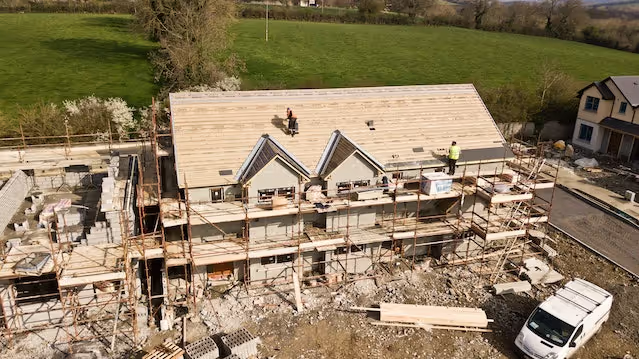
New Builds Versus Existing Properties: What Matters
You are reading an independently ranked global top-50 investing and finance blog. Become Wealth is independently owned, trusted to advise on over $1 billion, and one of only 49 New Zealand firms licensed to manage client portfolios directly.
A guide to what drives long-term returns when choosing between new build and existing investment properties in New Zealand.
The short version: the right answer depends on the investor, the property, and the numbers. New builds offer lower deposits, minimal maintenance, and simplicity. Existing properties often deliver stronger long-term capital growth through higher land content and location scarcity. Tax and lending rules change regularly and should inform your modelling, but never your entire investment approach. The factors most commentary overlooks, including land-to-improvement ratios, supply concentration, and the reality of holding-periods, are usually the ones worth paying most attention to.
New Builds vs Existing Properties: The Factor Most Investors Overlook
Here is a distinction rarely made in the new build conversation, yet it may be the single most important one for long-term wealth.
When you buy an existing property, you are typically purchasing a higher proportion of land relative to the structure on it. A three-bedroom home on a 600-square-metre section in an established Auckland suburb might derive 60 to 80 percent of its value from the land alone. The house is ageing. The land is appreciating.
A new build townhouse, by contrast, often sits on a small footprint in a high-density development. The building itself represents the majority of the purchase price. And buildings, unlike land, depreciate. They require maintenance. They age. Over a 20-year horizon, the investor who bought a larger proportion of land has typically done better in capital terms, because land in desirable, supply-constrained locations tends to appreciate while structures lose value in real terms.
This is not an argument against new builds. It is an argument for understanding what you are buying. A new build on a standalone section in a well-located Christchurch suburb is a very different proposition from a unit in a 40-townhouse development on the urban fringe. Both get marketed under the same “new build” label. The economics of each are vastly different.
Supply Concentration Risk in New Build Developments
Large-scale new build developments tend to deliver dozens of similar properties into the same area within a short timeframe. This creates a specific form of risk rarely discussed: supply concentration.
When 60 near-identical townhouses arrive on the market in a single development, every landlord in the complex competes for tenants from the same pool. Rental pricing power weakens. Vacancy risk during the initial lease-up period rises. And when it comes time to sell, comparable sales data can be unforgiving. Your neighbour’s identical unit, listed a week before yours, sets your ceiling.
Existing properties, bought individually in established suburbs, rarely suffer from this. Each property is different. Supply arrives incrementally, not in a wave. This matters most for investors building a portfolio, because concentration risk compounds across multiple purchases in the same development.
A 20-Year View: How New Build and Existing Property Returns Evolve
The best way to evaluate any property investment is through a full holding-period lens. Consider two hypothetical investors, each putting $200,000 of equity to work.
Investor A: New Build Townhouse
Investor A buys a $750,000 new build townhouse in a developing Auckland suburb. The property is well-built, warm, dry, and compliant with Healthy Homes standards from day one. Maintenance in the first 10 years is minimal. Tenant quality is high. The building carries a Master Build 10-Year Guarantee. Cash flow in the early years is relatively strong.
By year 15, the property needs its first major maintenance cycle: exterior repaint, heat pump replacement, flooring refresh, maybe a new kitchecn or bathroom. The structure is no longer “new.” Tenant expectations and rental premiums have normalised. Capital growth has tracked the broader market but has been moderated by a steady supply of newer builds competing in the same area.
Investor B: Existing Property in an Established Suburb
Investor B buys a $750,000 three-bedroom home on a full section in an established, well-located suburb. The property is older and the early years involve higher maintenance costs. Cash flow is tighter. However, the land component is substantial, and the suburb is supply-constrained with limited room for new development.
By year 15, the land has appreciated considerably. Although maintenance costs have accelerated, the investor has the option to renovate, subdivide the section, or simply hold. Scarcity in a sought-after location has done much of the heavy lifting.
The Key Insight
Neither approach is universally superior. But the financial outcomes diverge meaningfully depending on location, land content, and supply dynamics. Investors who focus exclusively on the first five years tend to prefer new builds. Those who model the full holding period, and can afford the cash-crunch, often reach a more balanced conclusion.
If you’re weighing up a specific property purchase and want to see how the long-term numbers compare, our property investment team can model it for you.
Practical Advantages: New Builds vs Existing Properties
Why Investors Buy New Builds
Maintenance costs are low in the early years. Modern insulation, ventilation, and heating mean the property meets Healthy Homes standards without additional work, and tenants benefit from a warmer, drier home. This tends to attract quality tenants and reduce vacancy periods. Build guarantees (such as the Master Build 10-Year Guarantee) provide protection against defects. For investors who lack the time or appetite for renovation, a new build offers simplicity.
Lending conditions are also more favourable. The Reserve Bank’s lending rules require lower deposits for new builds than for existing investment properties, which means investors can enter the market with less equity or achieve greater leverage. For many first-time property investors, this is the decisive factor. The size of that advantage depends on the terms available on property investment loans.
Why Investors Buy Existing Properties
Established suburbs come with proven rental demand, established infrastructure, school zones, transport links, and a track record of capital growth the investor can review before buying. There is less guesswork.
The renovation upside is available exclusively to existing property buyers. A well-executed renovation can force equity growth, improve rental yields, and reposition the property within its market. This is active value creation, not available with a new build purchased at retail price.
Existing properties also offer greater diversity. No two are identical, giving investors more negotiating leverage and better opportunities to find below-market purchases. In a development of 50 identical townhouses, the price is the price.
Tax and Lending Rules for NZ Property Investment: Important, Not Permanent
New Zealand’s property tax rules have changed repeatedly over the past decade. Bright-line test periods have moved from two years to five, then to ten, and back again. Interest deductibility has been removed, partially restored, and fully reinstated. Deposit requirements have shifted. The pattern is clear: these settings are political, and any government can change them.
At the time of writing, interest deductibility has been fully restored for all residential investment properties regardless of when they were purchased, though it is ring-fenced. The bright-line test sits at two years. New builds continue to receive more favourable treatment under the Reserve Bank’s lending rules, with lower deposit requirements compared with existing properties.
These settings matter for cash flow modelling and entry costs, and a good financial adviser will factor them into your numbers. But building an entire investment thesis around the current tax position is a mistake many investors have made before, sometimes painfully. Regulatory advantages are temporary. The characteristics of the property you purchase are permanent.
One consideration many investors overlook: the residential rental loss ring-fencing rules remain in force. If your rental expenses exceed your rental income in a given year, the resulting loss cannot be offset against your salary, wages, or business income. It can only be carried forward and used against future rental income. Many investors are accumulating significant ring-fenced losses from their property portfolios, losses they cannot use to reduce their other income, which is one of the risks of borrowing to invest. This applies whether the property is a new build or an existing home, and it is worth understanding before committing to any negatively geared purchase.
Different Investors, Different Answers
The question is not “are new builds better?” The question is “which is better for this investor, at this stage of life, with these objectives?”
First-time property investors often gravitate toward new builds for good reason. Lower deposit requirements reduce the barrier to entry. Minimal maintenance keeps holding costs predictable. For someone learning the ropes of property investment, a simple, low-touch asset makes sense.
Experienced investors with larger portfolios often shift toward existing properties over time. They have the equity, the knowledge, and the appetite to pursue renovation-driven value creation, subdivision opportunities, or supply-constrained locations where scarcity drives capital growth.
Owner-occupiers deciding between a new build and an existing home face a different calculus entirely. Lifestyle, commute times, school zones, and the simple enjoyment of living in a character home with a mature garden are legitimate factors. Not every property decision is purely financial.
New Builds vs Existing Properties at a Glance
New builds tend to suit investors who want:
- A lower deposit requirement and easier entry into the market
- Potentially higher cash flows, due to lower maintenance, and less compliance costs
- Minimal maintenance and predictable holding costs in the early years
- Healthy Homes compliance without additional work or cost
- A hands-off, low-touch investment experience
Existing properties tend to suit investors who want:
- Potentially stronger long-term capital growth through higher land content
- Location in supply-constrained, established suburbs with proven demand
- Renovation upside and the ability to force equity growth
- Greater diversity of purchasing options
In both cases, location remains a dominant driver of long-term returns. Every investor should stress-test their numbers against a scenario where interest rates rise, a vacancy occurs, or the market softens for two or three years. The investors who do well are rarely the ones who bought “new” or “existing.” They bought the right property at the right price, held it long enough, and structured their finances properly.
Need Help Running the Numbers?
At Become Wealth, we help investors evaluate property opportunities alongside their broader financial position. If you are considering a property purchase and want to make sure the numbers add up, get in touch with our team. Here’s how we work with clients.
Frequently Asked Questions
Are new builds a better investment than existing properties in New Zealand?
Not necessarily. New builds offer lower deposits, potentially higher cashflows, less maintenance, and Healthy Homes compliance from day one. Existing properties often deliver stronger long-term capital growth through higher land content and location scarcity. The best choice depends on the investor’s financial position, time horizon, and objectives.
Do new builds get better tax treatment than existing properties?
As of March 2026, interest deductibility has been fully restored for all residential investment properties, removing the previous tax advantage new builds held. New builds still receive more favourable treatment under the Reserve Bank’s lending rules, with lower deposit requirements. Tax and lending settings change regularly, so current rules should inform your modelling but not your entire investment thesis.
What is supply concentration risk in property investment?
When a large number of similar properties are delivered into the same area at the same time, landlords compete for tenants from the same pool, weakening rental pricing power. Resale values can also be constrained by comparable sales from identical units in the same development. This risk is specific to large-scale new build developments and does not typically affect existing properties purchased individually in established suburbs.
What are ring-fenced losses in NZ property investment?
If your rental expenses exceed your rental income in a given year, the resulting loss is ring-fenced. You cannot offset it against your salary, wages, or business income. The loss can only be carried forward and used against future rental income from your property portfolio. This applies to all residential investment properties, both new builds and existing. Note: tax rules are subject to change.

This article is general information which is not intended to provide financial advice of any kind. It does not take your circumstances into account. Nothing in this article constitutes a recommendation to buy, sell, or hold a financial product or other asset. For more information refer to our website terms and conditions, and financial advice provider disclosure.
Make better financial decisions
Fortnightly insights on investing, personal finances, retirement, KiwiSaver, tax, and property, so you can build and keep real wealth.


.jpg)