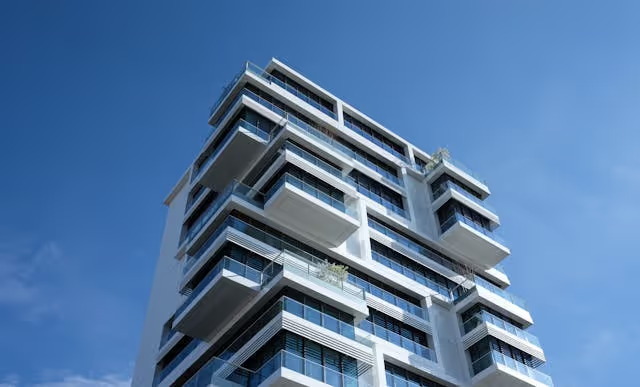
Buying Land to Build a House in NZ: Costs, Process, and Financing
You are reading an independently ranked global top-50 investing and finance blog. Become Wealth is independently owned, trusted to advise on over $1 billion, and one of only 49 New Zealand firms licensed to manage client portfolios directly.
Buying Land and Building a Home in New Zealand
Building a home on bare land in New Zealand typically costs upward of $1 million in urban centres and takes 12 to 24 months from land purchase to move-in. You will need a minimum 20% deposit on the section, a construction loan that releases funds in stages as your builder hits milestones, and a contingency buffer of at least 10% of the build cost.
For buyers with financial headroom and patience, building delivers full control over design, location, and long-term running costs. It is a poor fit for anyone on a tight budget, a short timeline, or without appetite for managing multiple professionals across overlapping workstreams. The process involves more moving parts than buying an existing property, and the financial commitments are less predictable.
Is Buying Land and Building Right for You?
Building suits buyers who want a home designed around how they live and who have enough deposit and income to absorb cost surprises. Marcus Mannering, Become Wealth's Christchurch-based Wealth and Lending Specialist, notes the clients with the smoothest building experience are consistently those who mapped out the full cost, including the holding period and dual payments during construction, before committing to a section.
If you are considering building as an investment, the tax treatment differs from existing properties in one important respect: interest on bare land is not deductible until a Code Compliance Certificate is issued and the property is available for rent. The tax section below explains how this works alongside the broader deductibility rules.
Building is a poor fit if your budget has no margin, if you need to move within six months, or if managing a project across an architect, builder, council, and lender sounds more stressful than appealing. For buyers who want a new home without the project management, house-and-land packages offer a simpler path with financing closer to a standard purchase.
Two buyers with identical deposits can face very different outcomes depending on the land. A flat, serviced section in an established subdivision is a far easier project than a sloping, unserviced rural lot requiring earthworks, retaining walls, and new utility connections.
The Process: From Land Search to Moving In
Every land-and-build project follows roughly the same sequence. Understanding the stages before you start prevents the most common and expensive mistakes.
1. Set Your Budget and Get Finance Pre-Approved
Before searching for land, establish what you can spend. Most New Zealand banks require a minimum 20% deposit for vacant residential land within urban boundaries. Lifestyle blocks and rural land typically require 30% to 50%. Banks also prefer evidence you intend to build: concept plans, a builder quote, or a clear timeline. A mortgage adviser experienced with construction lending can confirm what lenders will accept and structure finance to cover both the land purchase and the build.
2. Find Your Land
Sections are listed on Trade Me, RealEstate.co.nz, and through local agents. Subdivisions, council land releases, and word of mouth are also worth exploring. Pay attention to orientation (north-facing for passive solar gain), slope, access, and whether services are connected to the boundary.
3. Due Diligence
Due diligence on bare land is more involved than for an existing house. The section below covers what to check in detail.
4. Make a Conditional Offer
Your offer should be conditional on satisfactory due diligence (LIM report, geotechnical report, title search), finance approval, and ideally a preliminary assessment from your architect or designer confirming the section suits your intended build. Your lawyer should draft or review all conditions.
5. Engage Your Team
You will need an architect or residential designer, a builder (preferably a Licensed Building Practitioner), a surveyor, and a lawyer. Some buyers also engage a project manager for larger or complex builds. Getting your builder's input on the section before going unconditional can prevent expensive discoveries after settlement.
6. Obtain Consents
Under the Building Act 2004, a building consent is required before construction begins. You apply through your local council or a private Building Consent Authority. The statutory processing time is 20 working days, though many councils take 30 to 60 working days or longer. If your design does not comply with district plan rules (height, setbacks, site coverage), you may also need resource consent under the Resource Management Act 1991. Budget $2,000 to $10,000 or more for consent fees depending on project complexity.
7. Build
Construction of a standard home typically takes six to twelve months. Your bank releases construction loan funds in stages (usually five to seven draws) as milestones are reached: foundation, framing, lock-up, fit-out, and completion. Council inspections occur at defined stages. Once the build passes its final inspection, the council issues a Code Compliance Certificate confirming the work meets the Building Code. Your construction loan then converts to a standard mortgage.
What It Costs: A Worked Example
Cost uncertainty is the most common source of stress for people who build. Here is an indicative breakdown for a common scenario: purchasing a serviced 500m² section in a secondary city (Hamilton, Tauranga, or by some definitions, Christchurch) and building a 180m² mid-range home.
- Section purchase: $320,000
- Build cost (180m² at approximately $3,500/m², based on BRANZ industry estimates, 2025): $630,000
- Professional fees (architect, surveyor, geotechnical report): $25,000
- Consent fees and development contributions: $25,000
- Utility connections (serviced subdivision, minimal work required): $5,000
- Contingency at 10%: $63,000
- Total project cost: approximately $1,068,000
For comparison, recent REINZ median sale prices in Hamilton and Christchurch have sat between $700,000 and $850,000. Building typically costs more, but delivers a home built to current code with lower maintenance and, in many cases, a 10-year Master Build or Halo guarantee.
With a 20% deposit of roughly $214,000, the borrowing requirement is approximately $854,000. During construction (say nine months), funds are released progressively. Interest is charged only on the amount drawn, so early payments are lower and increase as each draw-down occurs. At a construction loan rate of around 6.5%, the average interest cost during the build phase might be approximately $2,300 per month, rising toward $4,600 per month by the final draw. After completion, a standard principal-and-interest mortgage on $854,000 over 30 years at approximately 6.0% would cost around $5,120 per month.
Build costs per square metre vary by region and specification. BRANZ industry estimates (2025) show a range from roughly $2,500/m² for a basic build to $4,500/m² or more for high-spec or architecturally designed homes, with Auckland and Queenstown at the higher end. Include the contingency. In our experience, the three most common sources of cost surprises are ground conditions discovered after earthworks begin, provisional sum adjustments on items like kitchen fittings or landscaping, and owner-initiated variations mid-build.
How Construction Loans Work in New Zealand
Construction finance is the area most buyers find unfamiliar. Unlike a standard home loan where the bank transfers the full amount at settlement, a construction loan releases money in stages as your builder completes agreed milestones. You pay interest only on the amount drawn, which means repayments start small and increase progressively.
Some banks offer a combined land-and-build loan. Others require separate facilities for the land and the construction. A fixed-price building contract makes lending simpler because the bank knows the total cost upfront. Cost-plus contracts (where the builder charges actual costs plus a margin) are harder to finance because the total is uncertain, and banks may require a larger deposit or a quantity surveyor's estimate.
If the build costs more than the approved loan facility, whether from variations, provisional sum overruns, or unforeseen site conditions, the bank will generally not release additional funds without a new application. The borrower must find the shortfall from savings or other sources. This is one of the strongest arguments for maintaining a genuine contingency buffer and scrutinising every provisional sum before signing the building contract.
During construction, you will likely also be paying rent or servicing an existing mortgage. This dual-cost period is one of the most underestimated financial pressures of building. Lenders assess your ability to service both obligations simultaneously, and your debt-to-income ratio becomes critical. If your income is variable or your existing commitments are high, a mortgage adviser who regularly handles construction lending can identify which lenders offer the most flexible draw-down facilities.
Due Diligence: What to Check Before You Buy
The due diligence checklist for bare land is longer and more consequential than for an existing home.
Legal
Obtain a title search through your lawyer to identify covenants (restrictions on design, materials, colours, planting), easements (rights others hold over your land for access or drainage), and registered interests. A certificate of title from Land Information New Zealand contains ownership history, boundaries, and encumbrances. In new subdivisions, a title may not yet be issued. Negotiate a sunset clause allowing you to withdraw if the title is not issued by a specified date.
Physical
Commission a geotechnical report ($2,000 to $5,000 or more depending on site complexity). A geotech assesses ground conditions, bearing capacity, liquefaction risk, and slope stability. Since the Canterbury earthquake sequence, councils have increasingly required geotech reports before granting building consent. Sloping sites may need retaining walls and earthworks, potentially adding tens of thousands to the build cost. Check for soil contamination on former orchard, industrial, or landfill sites using the HAIL list maintained by the Ministry for the Environment.
Infrastructure
Confirm access to water, wastewater, stormwater, power, gas, and internet. In a serviced subdivision, these are usually connected to the boundary for a few thousand dollars. On rural or unserviced land, connection costs can reach $20,000 to $100,000 or more, and you may need on-site solutions (bore water, septic system). Verify legal road access. Some sections rely on rights of way over neighbouring land.
Planning
Obtain a LIM report (Land Information Memorandum) from the local council, typically $200 to $500 and delivered within 10 working days. The LIM contains zoning information, hazard data, building consent history, and rates. Check the district plan for height limits, setback requirements, and site coverage rules. In Tier 1 urban areas (Auckland, Hamilton, Tauranga, Wellington, Christchurch), the Medium Density Residential Standards introduced under the Resource Management (Enabling Housing Supply and Other Matters) Amendment Act 2021 allow up to three dwellings of up to three storeys as a permitted activity in most residential zones. This may expand what you can build, particularly for investment purposes.
Buying in a Subdivision, on Standalone Land, or as a House-and-Land Package
A serviced subdivision is usually the simplest option for a first-time builder: flat sections, utilities connected, geotech reports often completed by the developer, and a known neighbourhood taking shape. The trade-offs are covenants that dictate design and limited individuality.
Standalone land (infill sites, rural sections, established areas) offers more freedom but more risk. You take full responsibility for due diligence, utility connections, and consenting.
House-and-land packages sit between the two. A developer sells the section bundled with a fixed-price build contract from a specified builder, often as a turnkey product. Financing is simpler, risk is lower, and the timeline is usually clearer. The compromise is limited design flexibility. A new build and an existing property differ on cost certainty, timeline, and design control, and the right answer depends on which of those matters most to you.
Protecting Yourself: Risks and How to Manage Them
Builder Insolvency
Several New Zealand building companies have collapsed in recent years, leaving homeowners with unfinished houses and limited recourse. New Zealand has weaker statutory protections than Australia's home building compensation schemes. Use only Licensed Building Practitioners (legally required for restricted building work), insist on a fixed-price contract where possible, and confirm your builder holds a Master Build Guarantee or Halo Guarantee. Read what those guarantees cover and their monetary limits. They are valuable but not comprehensive. Retention clauses in your building contract (withholding a percentage of each progress payment until completion) provide additional protection. If a dispute arises during or after the build, claims can be made through the Ministry of Business, Innovation and Employment's building disputes process.
Cost Overruns
Even with a fixed-price contract, variations (changes you request during the build) and provisional sums (allowances for items not yet priced precisely, like kitchen fittings or landscaping) can push the final cost well above the contract price. The 10% to 15% contingency in your budget exists for this reason. Review every provisional sum line in your contract before signing.
Insurance During the Build
Contract works insurance covers damage to the building during construction: fire, storm, vandalism, or accidental damage. Most building contracts require the homeowner to arrange this cover before construction begins, though some builders include it in their contract price. Confirm who holds the policy, what it covers, the sum insured, and whether it includes materials stored on-site. Standard home insurance does not apply until the build is complete and a Code Compliance Certificate has been issued.
Consent Delays
Building consent processing times vary by council and complexity. Some councils are consistently slower than the 20-working-day statutory period. A delayed consent delays your build start, extends your dual-cost period, and can push you into a different season. Factor this into your timeline from the outset.
Tax Considerations
Three tax rules affect land-and-build decisions.
First, interest deductibility. Since 1 April 2025, interest on residential investment property loans is fully deductible for all properties. However, interest on bare land is not deductible during the holding period before construction is complete. Under the Income Tax Act 2007, deductibility for a new-build investment begins only once a Code Compliance Certificate is issued and the property is available for rent. This distinction catches many investors off guard: you may hold land for 12 months or more while paying non-deductible interest.
Second, the bright-line test. Reduced to two years from 1 July 2024, it applies to residential land including bare sections. Any gain on land sold within two years is taxable, subject to the main home exclusion.
Third, land purchased with an intention of resale or as part of a development activity may be taxable regardless of holding period under the land dealer and developer provisions of the Income Tax Act 2007.
If you are weighing the investment case alongside your broader finances, professional tax advice is essential. A financial planning review before committing to a section can clarify how the build fits within your wider position.
How Long Does It All Take?
A realistic timeline from beginning your land search to moving into a completed home is 12 to 24 months.
- Land search and purchase: 1 to 6 months
- Design and consenting: 2 to 5 months
- Construction: 6 to 12 months
Delays at any stage compound. A consent that takes eight weeks instead of four pushes everything back. Building through a wet winter takes longer than a dry summer. Households that manage this well build realistic timelines from the start and treat the contingency buffer as essential.
Frequently Asked Questions
Can first-home buyers use a KiwiSaver first home withdrawal for bare land?
A KiwiSaver first home withdrawal can be used toward a land purchase if you intend to build your primary residence on it. You must have been a member of a KiwiSaver Scheme for at least three years to be eligible. First-home buyer lending options may also be available through Kāinga Ora's First Home Loan scheme, which allows purchases with as little as 5% deposit for eligible buyers and properties.
Can overseas buyers purchase residential land in New Zealand?
Generally, no. Under the Overseas Investment Act 2005, non-residents and overseas persons cannot purchase residential land (including bare sections) without Overseas Investment Office consent. New Zealand and Australian citizens and permanent residents ordinarily resident in New Zealand are exempt.
What is the difference between a fixed-price contract and a cost-plus contract?
A fixed-price contract locks in the total build cost upfront (excluding variations you initiate). A cost-plus contract charges actual labour and materials plus a builder's margin, meaning the final cost is unknown until completion. Banks strongly prefer fixed-price contracts, and they offer the buyer more budget certainty.
Bringing It Together
Buying land and building a home takes longer, costs more, and involves more moving parts than buying an existing property. For buyers who map out the full financial picture before committing, including deposit, construction draw-downs, dual-cost period, and contingency, the result is a home built to their specifications on land they chose.
Three questions determine whether you need professional help with the financing.
- Do you know how much you can borrow across both the land and the build?
- Have you stress-tested your budget for the dual-cost period?
- And have you confirmed which lenders will accept your building contract type?
If any answer is uncertain, talk to our lending team.

This article is general information which is not intended to provide financial advice of any kind. It does not take your circumstances into account. Nothing in this article constitutes a recommendation to buy, sell, or hold a financial product or other asset. For more information refer to our website terms and conditions, and financial advice provider disclosure.
Make better financial decisions
Fortnightly insights on investing, personal finances, retirement, KiwiSaver, tax, and property, so you can build and keep real wealth.
.jpg)