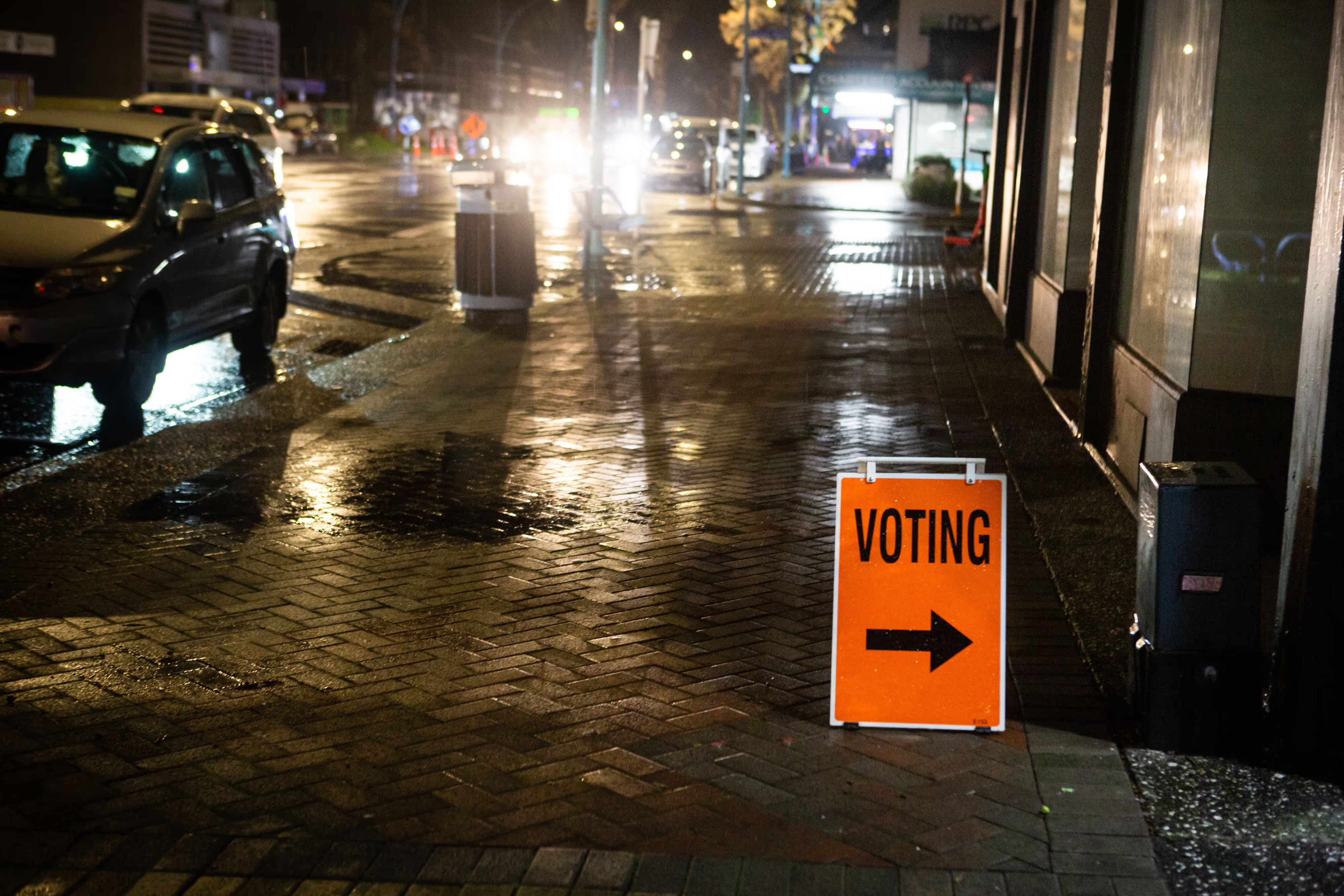
The Election and Your Finances
You are reading an independently ranked global top-50 investing and finance blog. Become Wealth is independently owned, trusted to advise on over $1 billion, and one of only 49 New Zealand firms licensed to manage client portfolios directly.
New Zealand heads to the polls on 7 November 2026. The campaign is warming up, the polls are tight, and every party is making promises designed to win your vote. Capital gains tax. Compulsory KiwiSaver. Wealth taxes. Inheritance taxes. The list goes on.
If you have savings, investments, or a mortgage, it is natural to wonder what all of it means for your finances. Over 160 years of market data, the answer is surprisingly consistent: elections barely move long-term returns.
Here is why, and what you should focus on instead.
Why NZ Elections Have Less Financial Impact Than You Think
Every election cycle follows a familiar script. Commentators speculate about which party is better for the economy. Social media fills with confident predictions. Friends and family insist the country is headed for ruin if the wrong lot gets in. It happens here, in Australia, in the United Kingdom, and in the United States.
The pattern is remarkably consistent, and so is the punchline.
Vanguard, one of the world's largest investment managers, has studied portfolio returns going back to 1860. Their conclusion? There is no statistical relationship between election years and the performance of a balanced portfolio. A 60/40 portfolio, 60 percent shares and 40 percent bonds, has delivered broadly similar returns regardless of who is in charge.
Closer to home, the NZX 50 tells a similar story. Since its launch in 2003, the index has delivered a total return exceeding 500 percent, or roughly 10 percent per year annualised. In the same period, New Zealand has had seven general elections, five prime ministers, and governments from both sides. The NZX rose through all of them.
Research from the Economics Observatory, drawing on academic studies spanning decades, confirms the broader point: while share prices can wobble in the days around polling day, the party in power makes limited difference to long-term market returns. The drivers of investment performance, including interest rates, corporate earnings, innovation, and global trade, operate at a scale far beyond what any single government controls.
This Election Has Sharper Tax Differences Than Most
In many election years, the two major parties agree on more than they would like to admit. Neither plans to dismantle NZ Superannuation, the single largest line item in the government's budget. Both want more affordable housing, and both accept housing supply is constrained by consent and planning rules. Both support New Zealand's general orientation toward open trade and free markets.
This year, the tax differences are wider than usual, and they reach assets directly. It is worth knowing what is on the table, because the headlines tend to flatten the detail.
Labour proposes a 28 percent capital gains tax on residential investment property and commercial property, taking effect from 1 July 2027. The family home, farms, KiwiSaver, shares, business assets, and inheritances are all exempt. Crucially, the tax is forward-looking: only gains made after 1 July 2027 would be taxed, with property values reset on that date. Labour has also ruled out a wealth tax and an inheritance tax.
National has put financial security at the centre of its offer. Its KiwiSaver package would make contributions compulsory for all workers from 1 July 2028, lift the combined default contribution rate to 12 percent by 2032 (matching Australia), add a $1,500 Baby Boost payment with automatic enrolment at birth, top up KiwiSaver during paid parental leave, and require employer contributions for workers over 65. Default contributions have already risen to 3.5 percent as of 1 April 2026. National is not proposing any new tax on assets.
The Green Party has the most expansive package. It proposes a 2.5 percent annual tax on net assets above $10 million per person (with the family home excluded), a 33 percent tax on inheritances and gifts received above $1 million, a higher corporate rate for the largest firms, a $10,000 tax-free income threshold, and a new top income rate of 45 percent on income over $160,000.
ACT, by contrast, favours a flatter system: a two-rate income tax with a top rate of 28 percent, aligning personal, trust, and company rates.
These asset taxes in particular deserve attention from anyone with an investment property or a substantial portfolio. But here is the point most people miss: campaign promises and implemented policy are very different things.
Why the Manifesto Is Rarely the Final Law
Under the Mixed Member Proportional (MMP) representation system, single-party government is rare. Coalition discussions frequently weaken, postpone, or remove policy goals, meaning the gap between campaign rhetoric and practical execution is often vast.
Two examples show the friction in practice. The last Labour government committed to building 100,000 homes over ten years, then delivered a little over 2,000 before the target was abandoned. The current government promised to scrap the bright-line property test, then settled for shortening it to two years rather than removing it. When power is shared, the original version of a proposal is usually reshaped by support partners to fit a broader consensus. Voters often see a significant difference between a party manifesto and the final legislation that emerges from Parliament.
There is a further filter specific to tax. Both Labour's and the Greens' asset taxes would take effect well after the election, and Labour and the Greens differ sharply on wealth and inheritance taxes, which any joint arrangement would have to reconcile. A policy announced in June 2026 is several steps away from being something you pay.
Genuine Risks Are Not Political
Here at Become Wealth, we are proudly apolitical. We do not have any political leanings or ties, and we do not make investment recommendations based on who is leading in the polls. What we do encourage is a focus on what you can control.
Most of the forces shaping your long-term financial outcomes operate well outside the reach of any New Zealand government. Global interest rate cycles are set by central banks responding to inflation, not by politicians. Technological innovation is driven by multinational corporations. Currency movements in the New Zealand Dollar are influenced by global capital flows and the monetary policies of much larger economies. Major geopolitical shifts, from trade conflicts to supply chain disruptions, are shaped by superpowers.
As a small, open, trade-dependent economy, New Zealand is largely a price-taker in global markets. A prime minister can shift the dial on domestic regulation and tax settings, but the forces above will have a far larger effect on your investment portfolio over any 10 or 20 year period.
The Costly Mistake People Make Every Election
The most expensive election-related decision is not voting for the wrong party. It is making a financial move you did not need to make.
T. Rowe Price, another global investment giant, examined S&P 500 returns across every presidential election since 1927. The difference between election-year and non-election-year returns is marginal and, statistically, could easily be explained by chance.
The same principle applies here. Selling shares because you are worried about a change of government, shifting your KiwiSaver investment to a conservative fund just until the election is over, or delaying a decision to borrow and invest because of political uncertainty are all forms of market timing. And market timing, as the evidence overwhelmingly shows, destroys more wealth than it protects.
What You Should Do Before the Election
Instead of reacting to campaign noise, the months before an election are a perfectly good time to focus on the basics. These are worth doing regardless of who wins:
- Review your financial plan. Not because of the election, but because regular reviews are how good plans stay good. Are your goals still the same? Is your risk profile still appropriate? Have you ticked off some achievements? Re-evaluate, then carry on.
- Check your KiwiSaver Scheme settings. Are you in the right fund type for your age and retirement timeline? This matters far more than which party wins. Many New Zealanders are in default funds not well matched to their actual risk tolerance or time horizon.
- Understand your tax position. If a capital gains tax on investment and commercial property does eventuate, it would apply prospectively, from a set start date, not retrospectively. Selling assets to avoid a tax not yet in existence, one which may never exist in its proposed form, is speculation rather than planning.
- Keep contributing and stay invested. The power of regular contributions to a diversified portfolio, compounding over decades, dwarfs the short-term noise of any election. This is how wealthy New Zealanders tend to invest, and it is not a coincidence.
Will the Election Affect House Prices or KiwiSaver?
Elections can create a brief pause in buyer and seller confidence, but the underlying drivers of house prices, including supply, population growth, interest rates, and credit availability, are far more influential. No New Zealand election in recent memory has caused a lasting shift in the housing market. If you are buying or selling based on your personal circumstances and timeline, the election should not change your financial outlook.
The same goes for KiwiSaver. Your KiwiSaver investment fund choice should be based on your age, aims, risk tolerance, other assets, and how many years you have until retirement. If you are decades away and in a growth or aggressive fund, staying there through election cycles has historically delivered better outcomes than switching to conservative options and back. It is worth noting that KiwiSaver investments and listed shares sit outside Labour's proposed capital gains tax entirely.
And if Labour's proposed capital gains tax on investment and commercial property does pass? It would apply only to gains made after the start date, with property values reset at that point. Making reactive decisions now, based on a policy from a party not yet in government and subject to coalition negotiations it has not yet had, is premature at best. New Zealand has been debating a capital gains tax since the 1970s. It has not been implemented despite multiple attempts, by both major parties.
History backs this up, and property is the clearest example. Over the past 25 years, the national median house price has risen more than fourfold, from around $170,000 in 2000 to roughly $790,000 by the end of 2025. That climb happened under Labour-led and National-led governments alike, with coalition partners of every stripe along the way. Prices rose through the 2000s under Labour, kept rising through the 2010s under National, surged again in 2020 and 2021 under Labour, then fell sharply from 2022, a decline that began under Labour and carried into the current National-led government. Governments of both colours came and went. House prices kept climbing regardless.
What moved prices was rarely the party in power. The 2020 to 2021 boom, when values jumped more than 25 percent in barely a year, followed the Reserve Bank cutting the Official Cash Rate to 0.25 percent, printing money (quantitative easing), and lifting lending restrictions during the pandemic. The same thing happened in reverse from late 2021, when the RBNZ pushed the cash rate from 0.25 percent to 5.5 percent in its steepest tightening on record and prices fell furthest in the cities that had risen furthest. New Zealand was not unusual here. House prices rose across most developed economies in 2020 for the same reason: globally low interest rates, not local election results. Interest rates, credit availability, migration, and construction costs do the heavy lifting.
Government does shape housing. Planning rules, consenting, and land supply are set by policy, and those settings matter a great deal over decades. But they are slow-moving, largely bipartisan in direction, and bear little relation to which party wins a single election. If you are weighing a property decision, the cash rate, your borrowing capacity, your goals, and your own timeline will tell you far more than the polls will.
New Zealand Elections and Your Finances
Elections matter. They shape public policy, determine government priorities, and reflect the values of the society we want to live in. Vote thoughtfully, by all means.
But do not let the campaign reshape your financial life. The evidence, accumulated across centuries and continents, is clear: the best financial decisions are the ones made with a long-term view, a diversified portfolio, and a healthy indifference to the 24-hour news cycle. Governments change every few years. Compound returns work for decades.
If you would like a second opinion on whether your finances are positioned to weather any election result, get in touch. No politics required, just a clear-eyed look at where you stand and where you could be headed.

This article is general information which is not intended to provide financial advice of any kind. It does not take your circumstances into account. Nothing in this article constitutes a recommendation to buy, sell, or hold a financial product or other asset. For more information refer to our website terms and conditions, and financial advice provider disclosure.
Make better financial decisions
Fortnightly insights on investing, personal finances, retirement, KiwiSaver, tax, and property, so you can build and keep real wealth.